History,
History of Phosphate Mine,
Pre-1880
50 Years of Production at the Aurora Phosphate Operations
The first interest in mining phosphate in Beaufort County came in 1951 when AMCO Exploration Inc., a subsidiary of American Metals Climax, started exploration for phosphate and obtained leases from the state for phosphate-bearing minerals underlying the Pamlico River and tributaries from a point six miles upstream from the city of Washington, N.C., to thirty miles downstream of Washington, N.C. In 1953 AMCO Exploration cancelled the leases after conducting minimal exploration.
Kennecott Copper, through its subsidiary, Bear Creek Mining, and Sun Oil, through its subsidiary, General Crude Oil, acquired these leases and began to explore for phosphate in Beaufort County. Both companies withdrew from the area in 1958 after attempts to vertical borehole mine the phosphate failed. The first encouraging report on the phosphate potential in the area was presented by Phillip M. Brown of the U.S. Geological Survey in 1958, indicating a major phosphate ore body of economic importance along with a theory of the possible origin of the phosphate deposit in Beaufort County.
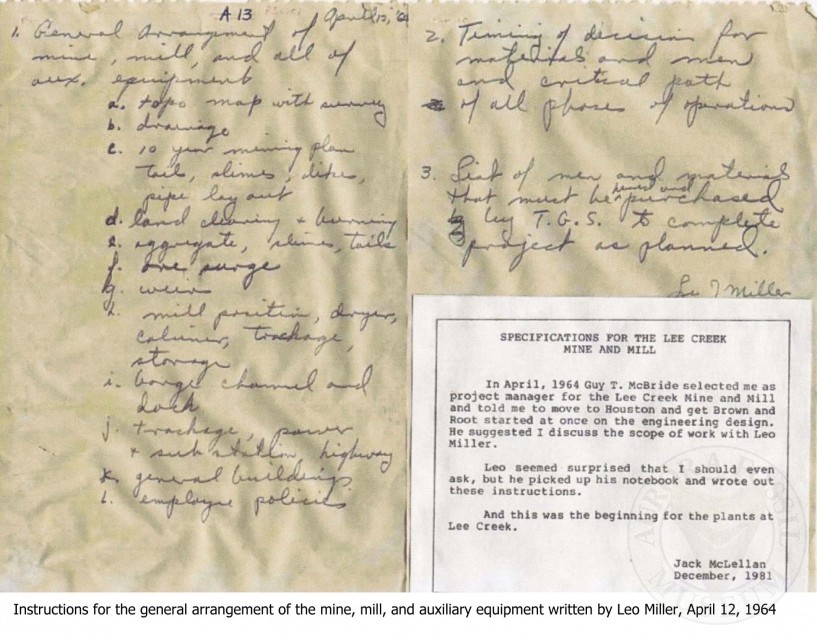
Texas Gulf Sulfur (TGS) looked at North Carolina phosphates in 1959 but considered the mining cost prohibitive at that time. In the spring of 1961, Dr. Leo J. Miller of TGS moved to Beaufort County and began making a reconnaissance survey of the reported phosphate deposit. In the summer of 1962 Dr. Miller concluded that, based on his gamma-logging of local water wells, he was fully justified in concentrating development efforts on the south side of the Pamlico River.

In September of 1962, Dr. Miller moved his office into the Professional Building at 213 N. Market Street in Washington, between the newspaper office and the Post Office. In September of 1963, Dr. Miller wanted the company's offices nearer to the test pit operation, so the offices were moved from Washington to a small wood building next to the test pit near Lee Creek.

Major problems complicated the development of the phosphate deposit. Mining the phosphate deposit required operating below sea level near an estuary. The phosphate deposit is overlain by much overburden ranging from 70 to 150 feet in thickness and underlain by a major artesian aquifer, known as the Castle Hayne formation. Dr. Miller overcame these problems during test pit mining in 1963 and completing an extensive pumping test project in 1964.

Funding for the construction of the mine, mill and chemical processing facilities began in 1964. The port at Morehead City was setup to accommodate the export of North Carolina phosphate products.

Between 1963 and 1966, under the project management of Dr. Miller, the initial mining and processing facilities were constructed on the present site. Full scale mining began in December 1965 and the first shipment of phosphate products from the facility occurred in April of 1966.

The phosphate operation continues, now over fifty years later, as
Nutrien Phosphate Aurora. The facility produces many high quality phosphate products and continues to help feed a hungry world.
Information provided by: "Tex" Ivan K. Gilmore, P.G., C.P.G., Senior Mining Geologist Groundwater Management Associates, Inc.