Shark Dentitions | Aurora Fossil Museum
The Aurora Fossil Museum houses dentitions of modern and fossilized shark species in its dentition hall.


Shark Dentitions
Our Collections:
Collections,
Shark Fossils,
Shark Dentitions,
Shark Tooth Identification,
Megalodon,
Lee Creek Parotodus
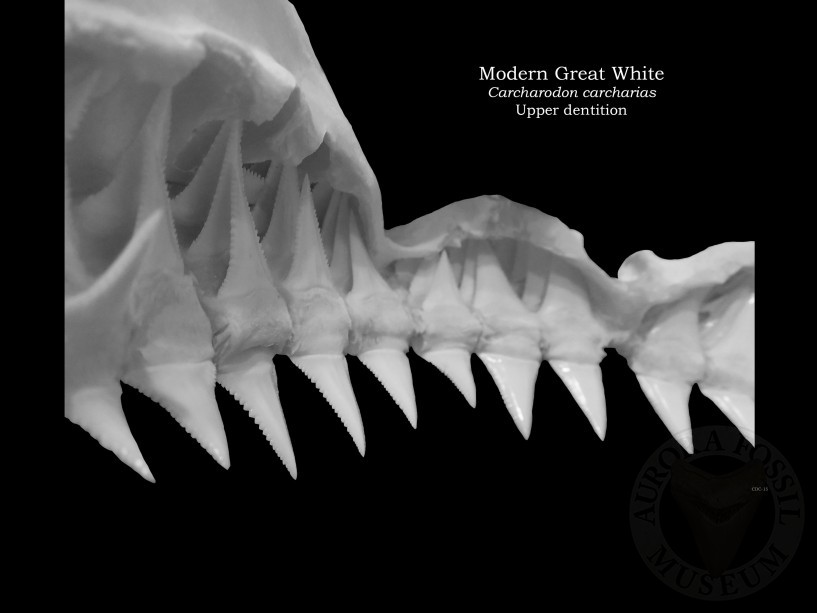
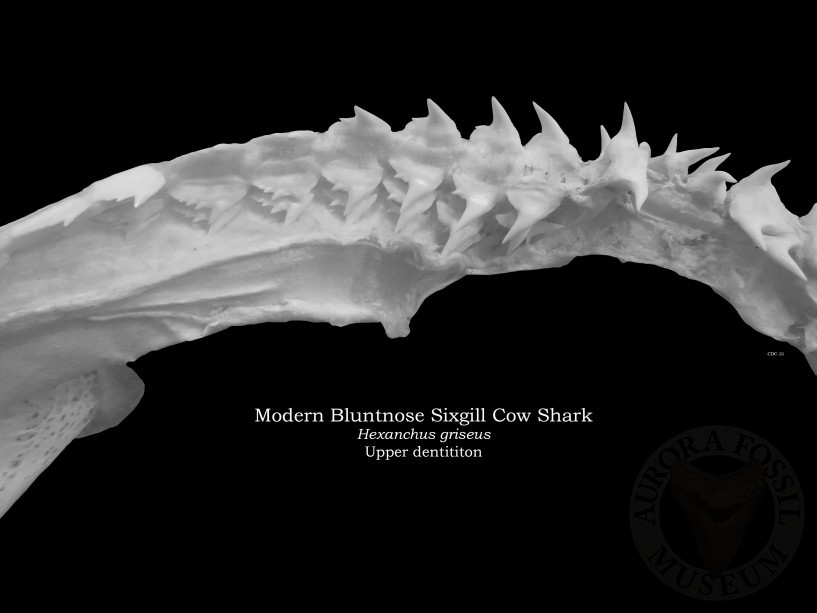
 The Aurora Fossil Museum houses comparisons of modern and ancient shark dentitions (jaws) in the Dentition Hall. The fossil species on display in the Dentition Hall are representative (actual or casts) examples of species found in the PotashCorp-Aurora Mine. There are 3 basic types of shark dentitions on display: •Associated: All teeth are from one individual (extremely rare) •Composite: An assemblage of teeth from multiple specimens •Artificial: Teeth that have been cast from original specimens Sharks possess an array of dentitions which are dependent on their mode of life, habitat, and foraging characteristics. You can interpret a great deal of how a shark functioned in life simply by looking at its teeth and dentition. A few of the typical dentition forms are: HOMODONT:Teeth that are similar in appearance (shape) but not necessarily in size.•Clutching: This type of dentition is rather common in shark species and is often found in small sharks that forage on the ocean floor and inshore habitats. The dentition consists of numerous small homodont teeth. The teeth are multi-cusped and are well designed for grasping hard-bodied prey such as bivalves, crabs, and urchins. An example of a shark with a clutching dentition is the Nurse Shark (Ginglymostoma sp.). •Grasping: This type of dentition consists of very slender and pointed homodont teeth. The long tip of the tooth coupled with its branched base gives the tooth a t-shaped form. The small surface area of the tooth tip allows it to be driven into soft flesh with ease. Grasping teeth are designed for sharks who forage in open mid-to deep waters and generally swallow their prey whole. An example of a shark with a grasping dentition is the Black Tip Shark (Carcharhinus limbatus sp.).  •Vestigial: This form of dentition consists of small, homodont, hook-shaped teeth. This type is reserved for sharks that specialize in filter feeding. Examples of sharks with vestigial dentitions are Whale Sharks, Basking Sharks, and the Megamouth Shark. •Cutting: This is a typical type of dentition for sharks with teeth specifically adapted for slicing. The homodont teeth are razor-sharp, often serrated, and generally have a triangular shape, pointed tip, and a wide base giving the tooth a heart-shaped appearance. An exception to the triangular shape is that of the Cow Shark (Notorynchus sp.) whose teeth have multiple points along the same plane. 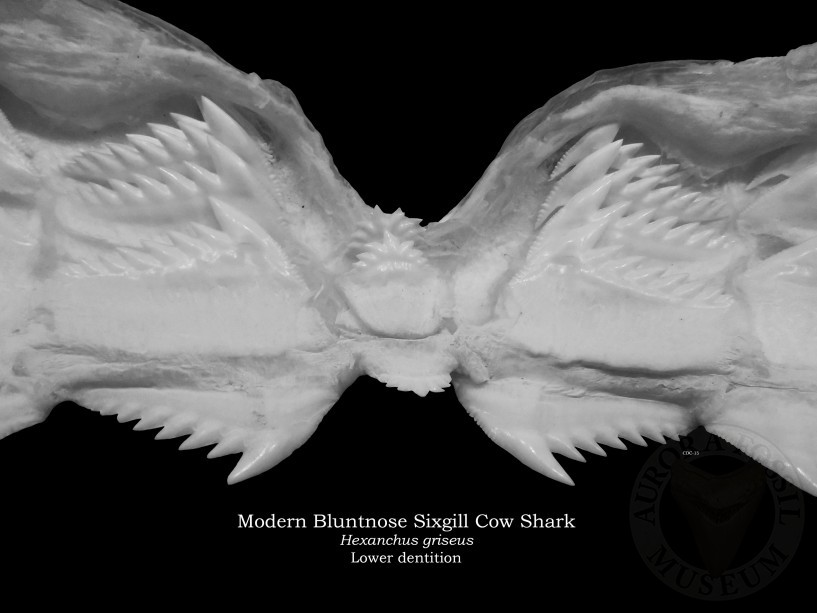
Sharks with a cutting dentition permit the shark to inflict severe injury to their intended prey by producing deep gashes causing extensive blood loss and shock. Sharks possessing the cutting dentition usually inhabit middle to open ocean environments and forage on fish, turtles and mammals. An example of a shark with a cutting dentition with highly serrated teeth is that of a Tiger Shark (Galeocerdo cuvier). 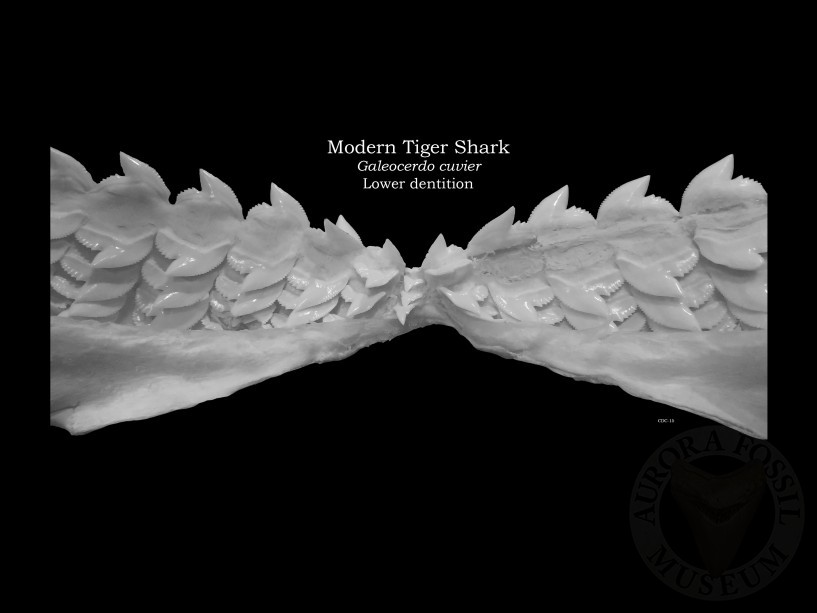
•Crushing: This dentition is uncommon yet distinguishing in shark species that possess it. Sharks with this type of homodont, asymmetrical, and flattened teeth are typically associated with benthic, nearshore feeding environments foraging on crustaceans. The dusky smooth-hound dogfish shark species (Mustelus sp.) possess this type of dentition. HETERODONT:Teeth that are different in appearance/shape. •Cutting-clutching/grapsing: This form is one of the most common dentitions in sharks. It is heterodont and has cutting teeth for slicing prey on one jaw, and grasping teeth for snagging and anchoring prey on the other. Snaggletooth Sharks (Hemipristis sp.) and certain species of Carcharhinus possess this type of dentition. Sharks with cutting-grasping dentitions live in open ocean waters and move nearshore for hunting prey that consists of fish, squid, and aquatic mammals. •Grasping-cutting: Similar to the cutting-grasping dentition, sharks with the heterodont grasping-cutting dentition have grasping teeth that snag and anchor prey in the front (anterior) region of their jaws. The cutting teeth are located in the back (posterior) of their jaws. 
Sharks that possess the grasping-cutting dentition are commonly found in open ocean waters and prey on fish and squid. An example of a shark species that has this form of dentition is the Longfin Mako (Isurus paucus). •Grasping-crushing: This type of heterodont dentition has grasping teeth positioned in the anterior (front) region of the jaw with the crushing teeth (for compressing and cracking shelled prey) located posteriorly (in the back). Sharks possessing this form of dentition forage on a variety of fish in nearshore environments. A modern example of a shark with the grasping-crushing dentition is the smalltooth sandtiger shark (Odontaspis ferox). •Clutching-crushing: This form of heterodont dentition is unique among sharks. They exhibit clutching-type teeth to clasp on to prey in the anterior region of the jaw and crushing-type teeth to pulverize hard-bodied prey posteriorly. A shark with this form of dentition is often located in nearshore, benthic environments feeding on mollusks, crustaceans, and fish. Modern examples of sharks with clutching-crushing dentitions are the Zebra Bullhead Shark (Heterodontus zebra) and the Crested Bullhead Shark (Heterodontus galeatus). Text and images by C. Crane, 2015 References: • swc.colostate.edu (sharkparttwo.pdf) • paleobiology.si.edu (sharktoothKey.pdf) Related Links• Shark Fossils• Cetacean Fossils • Shark Tooth Identification • Megalodon • Lee Creek Parotodus |