Our Collections:
Collections,
Shark Fossils,
Shark Dentitions,
Shark Tooth Identification,
Megalodon,
Lee Creek Parotodus
Aurora, North Carolina is famous for its continually rich supply of pre-historic mammal and sea life findings. One very predominant finding happened in the Fall of 1992. Below is a description of the discovery of a nearly complete dentition (set of teeth), of a rare lamnid shark found in Aurora, NC.

Lee Creek Parotodus benedenii Associated Dentition
The Lee Creek Mine (formally PotashCorp-Aurora, currently Nutrien) located in Aurora, NC is one of the most important scientific localities in the world for Miocene and Pliocene fossils that have been studied extensively by the Smithsonian Institution for over 40 years. The Lee Creek Mine holds a place of honor among all of the premiere fossil sites on the planet, and the number of important finds from this locality is countless.
One such discovery took place in the Fall of 1992 when a nearly complete dentition (114 teeth in all) of the rare lamnid shark
Parotodus benedenii was recovered from a spoil pile of the Yorktown Formation (early Pliocene) in the mine. This discovery was significant for several reasons. First of all, finding associated sharks teeth from a single shark is an extremely rare occurrence. The fact that the associated teeth belonged to a rare shark such as
Parotodus benedenii and that the number of teeth recovered exceeded 100 made the discovery all the more remarkable. The assemblage of teeth was discovered in a very small area (a few meters by a few meters) on one face of a single spoil pile. To say that this was a rare occurrence is an understatement.
The site of the associated teeth was first discovered by Clyde Swindell when he found several teeth laying on the surface and thought that there was the possibility of more associated teeth buried under the sediment. With the assistance of amateur collectors George Powell Jr., Becky Heine, and many other volunteers and under the watchful eye of Dr. Bretton Kent, the site was excavated with the use of a water pump. A total of 114 teeth were subsequently discovered during 20 collecting trips over the course of a year. The teeth collected were large for the species and in great condition which is typical for sharks teeth collected in the Lee Creek Mine.
After the collection of the assemblage, the painstaking task of recreating the dentition began in Dr. Kent's lab at the University of Maryland. With George Powell Jr.'s assistance, Dr. Kent set out proving that the teeth did indeed belong to a single shark. Using exact measurements, water displacement, and dentition position of each individual tooth Dr. Kent was successful in recreating the dentition of the Lee Creek
Parotodus benedenii . Finally, after two years of tedious work, the dentition was completed. The entire process was later published in a scientific paper in 1999 with Dr. Kent as the senior author and George Powell as the junior author.
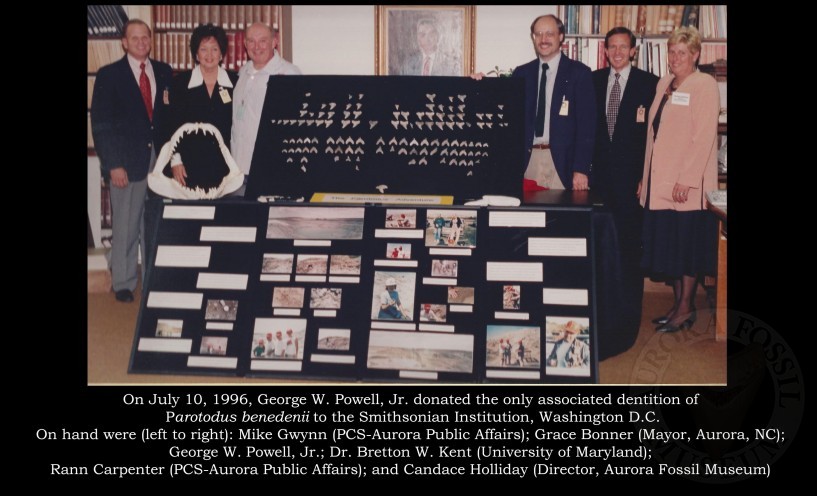
On July 10, 1996, the
Parotodus benedenii dentition was donated to the Smithsonian Institution during a dedication ceremony. In attendance were George Powell Jr., Dr. Bretton Kent, Candace Holliday (Director of the Aurora Fossil Museum), Grace Bonner (Mayor of Aurora), and dignitaries from PotashCorp-Aurora Mike Gwynn and Rann Carpenter. During the ceremony, Dr. David Pawson of the Smithsonian stated that, "The
Parotodus benedenii dentition is the fossil shark equivalent of the Mona Lisa, something unique and beautiful that will always be available for study."
Three casts were made from the original teeth. One such set was donated and is on permanent display at the Aurora Fossil Museum. We encourage you to come see this magnificent and scientifically important display at the Aurora Fossil Museum.

Related Links
•
Shark Fossils
•
Stingray Fossils
•
Cetacean Fossils
•
Shark Dentitions
•
Shark Tooth Identification
•
Megalodon
•
A Whale of A Challenge